And what it is going to take is not another event. Not another building with innovation in the name. It is a repeatable system, one that connects talent to capital, research to commercialization, founders to procurement, and all of it to a regional strategy across cities and counties that compounds over time instead of resetting every grant cycle. The connective tissue that does not just celebrate the ecosystem but structurally advances it.
Innovate Orlando, as it was, was not that system. I say that with full ownership. I ran it. And what I learned running it is that this work cannot live outside the larger regional economic development infrastructure. It has to be woven into it, or it spends all of its energy trying to be heard by the rooms it needs to be inside.
That is why this decision is not hard. It is overdue.
I wanted you to hear this directly from me: Innovate Orlando is transitioning its mission and programs back to the Orlando Economic Partnership, and I am returning with them as Vice President of Innovation, effective March 9.
This is about finding the right partnerships, alignments, and connected momentum to do this work at the scale it deserves. Moving this work inside the Orlando Economic Partnership means the mission is now backed by the full infrastructure of regional government, industry, academia, and community partners working toward the same goal. The platform is bigger. The reach is longer. The mission can have the infrastructure to match its ambition.
Tech Connect, the Orlando Tech Summit and Community Awards, and the Orlando Tech Grant all make the move. What comes next is not another program or another event. It is a repeatable system, one that connects talent to capital, research to commercialization, founders to procurement, and all of it to a regional strategy that compounds over time instead of resetting every grant cycle.
This is not a step away from the work. It is the work, finally in the right kitchen. Orlando does not need more cheerleaders. It needs infrastructure that works.
Now scroll down. Because this week’s news is exactly the argument I have been making the entire time. A Central Florida AV company is heading to the FIFA World Cup. UCF just launched a $3.5 billion campaign, its largest in history. An Orlando cybersecurity company hosted a national conference in our own backyard. Space Florida opened a $531M call for projects. And that is just the headline layer. The full picture is below, and it will remind you why this region is not waiting to be discovered. It never was.
Space Coast and Aerospace
Read these four stories as phases of a single capital formation sequence. Public infrastructure investment comes first and de-risks everything that follows. Private real estate comes second, signaling long-term operational commitment. International capital comes third, validating that the region can compete globally. NASA is the backdrop that makes all three moves legible.
Blue Origin’s $11.5M land acquisition in Cocoa is the kind of move a company makes when it has already decided the Space Coast is a long-term operating address, not a launch convenience. That decision compounds against Space Florida’s 2026 Spaceport Improvement Program, which just opened a call for projects backed by $531M in state investment, essentially a public infrastructure commitment that de-risks the private capital following behind it. EOS-X Space’s acquisition of Space Perspective and its $650M+ combined valuation shows what happens when international aerospace capital looks for a U.S. home and finds that this region has both the infrastructure and the talent density to justify the bet. NASA’s Artemis 2 timeline, still targeting April, is the backdrop to all of it. When public investment, private real estate, and international capital are all moving in the same direction at the same time, that is not momentum. That is a thesis becoming infrastructure.
Defense, Drones and Cybersecurity
Read these five stories as a demand signal map. The government signals what it needs. The private sector builds the product. The universities build the workforce. Then the cycle repeats at a higher level. Every story in this section is a different point on that loop.
Orange County’s $7M drone-as-first-responder program is a local government buying what the private market has already proven works, a direct downstream effect of companies and researchers in this region building real-world drone operations for years. Central Florida’s role in the missile defense planning conversation runs directly through the modeling and simulation corridor, home to more than 15,000 simulation professionals working across systems that range from missile guidance and radar tracking to autonomous vehicle training and pilot readiness. That is the digital infrastructure missile defense architecture requires before a physical system is ever built. The golden dome starts with a digital twin, and this region is where those twins get made.
ThreatLocker’s Zero Trust World conference just made that demand signal visible to thousands of security professionals gathered in Orlando this week, and Embry-Riddle answered with both a new aviation cybersecurity certification program and a drone-based research deployment on Lake Okeechobee. Those same hyperspectral imaging and autonomous sampling systems being used to study algae blooms can be adapted for border surveillance, maritime patrol, and environmental threat detection. Embry-Riddle is not just doing environmental research. It is building the operational proof of concept for a capability the defense community is actively looking for. These stories are not parallel. They are sequential. The research produces the workforce. The workforce builds the products. The products win the contracts. The contracts fund the next round of research.
Health Tech and Life Sciences
Read these three stories as a pipeline, not a cluster. The forum sets the agenda. The research fills it. The talent exports validate it globally and come back. That is how a health tech ecosystem matures.
Lake Nona’s Impact Forum argument, that longevity is inseparable from technology, is easy to endorse on a panel stage. What makes it credible is the research pipeline sitting behind it. A UCF researcher developing a new therapy for diabetic neuropathy is working on a condition that affects more than 50% of people with diabetes and has no FDA-approved cure, the kind of gap that attracts serious capital once clinical proof of concept exists. A UCF doctoral graduate heading to Harvard Medical School to advance AI-driven clinical tools is exactly the talent export story that benchmarks a region’s research quality on a national stage, even as it feels like a loss locally. Orlando’s health tech ecosystem is not built on one medical city with good architecture. It is built on a university research pipeline that feeds institutions like Harvard, and on applied science that is moving toward the clinic. Lake Nona is the platform. UCF is the engine underneath it.
Research, Talent and University Innovation
If you wanted to design a regional innovation ecosystem from scratch, you would do something that looks very much like what Central Florida’s universities are doing right now. UCF’s $3.5 billion Go For Launch campaign is the largest fundraising effort in the university’s history and it is essentially a capital formation event for the ecosystem. The proceeds flow into research infrastructure, scholarships, and facilities that the private sector will benefit from directly. The $4M electron microscope is a small illustration of the larger logic: UCF is not just training students, it is building shared research infrastructure that companies in the region can access without owning. Rollins College’s addition of the Rick Goings Institute to its $200M Innovation Triangle takes a different approach, connecting liberal arts education to entrepreneurship and economic development, a bet that the skills gap in the innovation economy is not purely technical.
And at Full Sail University in Winter Park, my alma mater, student filmmakers just landed finalist spots in the Coca-Cola Refreshing Films competition, a precise illustration of what happens when production-focused education puts students on national stages before they graduate. These institutions are not competing. They are covering different parts of the same talent and research formation problem, and the aggregate investment this week runs well past $3.7 billion. That is not coincidence. That is a coordinated institutional bet on this region’s trajectory.
Startups, Capital and Business Growth
Read these four stories as a capital stack, not as isolated company announcements. FirmPilot’s $22M Series A-1 in AI legal marketing is venture capital flowing into vertical SaaS, a signal that investors see Orlando-area companies as credible bets at growth-stage check sizes, not just seed experiments. Kore.ai’s strategic growth investment from AllianceBernstein is institutional private credit entering the enterprise AI story through an Orlando-headquartered company, a different flavor of capital, from a different part of the market, validating a different stage of growth. RSG Security’s California expansion and Laser Photonics’ consolidation to Lake Mary are operational scaling stories, not fundraising announcements. They represent companies that have already raised and are now executing. Together, the four companies span early growth, scale-up, and operational maturity. That is what a functioning startup ecosystem looks like when it is working: multiple companies at multiple stages, attracting multiple types of capital, and still calling Central Florida home.
One gap this newsletter never fully closed is the capital formation story itself. Who is writing the checks in Orlando? What does the fund landscape actually look like? Where does a founder go when they need a Series A and do not want to fly to San Francisco to get it? That is the story I am most eager to tell from inside OEP, where the relationships between capital, institutions, and founders can be mapped and connected at regional scale.
Tech Infrastructure and Economic Development
Read these three stories as a market validation sequence. First tenant, first mobility operator, first AV deployment at global scale. Each one lowers the risk for everything that follows.
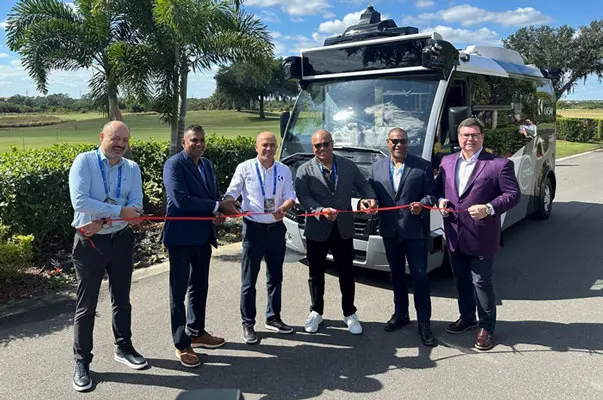
Terracon signing as the first tenant at the Lake Mary Technology Center is significant not for the lease itself but for what a first tenant signals to every tenant that follows. The anchor has arrived, the risk has been absorbed, the address is legitimate. Freebee’s EV rideshare launch in Lake Nona works the same way: it is a Miami company choosing a Central Florida innovation district as its expansion market, which tells you something about how that district is perceived by operators making real capital allocation decisions outside of Florida. Beep is the furthest along of the three. An Altamonte Springs company that built the first permanent AV deployment by any U.S. city is now carrying 150,000 kilometers of verified real-world operations into the FIFA World Cup in Atlanta. That is a Central Florida company writing the operational playbook for autonomous mobility on a global stage. The infrastructure layer of this ecosystem is not background. It is the proof of concept that makes everything else fundable.
In Case You Missed It
SpaceX’s March 3 Starlink launch from Cape Canaveral produced a jellyfish atmospheric effect visible across Central Florida, striking enough that it trended locally, routine enough that it barely made the business press. That tension is itself a story: Florida’s spaceport is now launching so frequently that rocket plumes have become regional weather. NASA’s separate announcement of a major change to its long-term lunar architecture adds policy context to the Artemis 2 repair timeline. Watch this space as the downstream implications for Kennedy and the Space Coast supply chain come into focus. Team Orlando’s SERDP and ESTCP wildland fire safety tabletop exchange is the quietest story of the week, but it is exactly the kind of cross-sector defense research collaboration that keeps the connective tissue of this community intact between the larger headlines. And an Orlando-area studio launches Everwind, a sandbox survival RPG, on Steam Early Access March 17, a Central Florida game going live on one of the world’s largest gaming platforms.
Thank You
This newsletter was never the point. It was evidence.
Evidence that this ecosystem had stories worth telling. Evidence that the founders, researchers, operators, and investors building in Orlando deserved the same attention as the regions that simply had better PR. Evidence that connective tissue, the unglamorous, unsponsored, unsexy work of linking people and ideas and capital across a geography, is the difference between a collection of companies and an actual ecosystem.
That evidence is now substantial.
David Adelson built the foundation. Ashley McMullan built it with me week after week. Our sponsors and board made the long bet. This community showed up and proved it was worth making.
The next chapter of this work continues at the Orlando Economic Partnership. Stay connected. Keep submitting. Keep showing up to the summits, applying for the grants, and making the introductions that move this ecosystem forward. The connective tissue holds because you hold it.
And if you have a story worth telling, you already know where to find me.
— Sheena Fowler

Join the movement by becoming an investor in Innovate Orlando to propel Central Florida’s tech and innovation ecosystem
| Join Now |
Investor Highlight
Florida High Tech Corridor is a vital force in Central Florida’s innovation ecosystem, bringing together world-class research institutions like the University of Central Florida and a collaborative network of industry, academia, and economic partners to grow high-tech industries and opportunities across a 23-county region. Anchored by Orlando’s thriving technology community,
The Corridor fuels innovation through strategic research partnerships, workforce development programs, and initiatives that help startups and established firms alike advance cutting-edge technologies and talent pipelines. Its dedication to boundary-breaking collaboration and community-driven innovation accelerates economic growth, strengthens Orlando’s role as a regional tech hub, and fosters long-term prosperity across sectors from aerospace to life sciences.
Learn more at: Florida High Tech Corridor
Innovate Orlando News
AMPLIFY CENTRAL FLORIDA CONSORTIUM: VISIBILITY FOR THE REGION’S INNOVATORS
Central Florida is emerging as a national hub for technology, simulation, space, health innovation, and cleantech but small and mid-sized enterprises often lack the resources to compete with global brands shaping online narratives. The new Amplify Central Florida Consortium provides shared-investment marketing infrastructure for forward-thinking companies, delivering enterprise-grade branding, multimedia production, and strategic communications.
Membership tiers (preferred rates through March 2026):
- Visibility Package: $450 (BlinkCo. Mag feature reaching 1M+ viewers)
- Video Essential Kit: $2,975/mo (monthly production session, 3-mo commitment)
- Lifestyle Story Kit: $4,025/mo (30-day content plan + cinematic video)
- Prestige Feature Kit: $5,075/mo (8-12 short-form videos + BlinkCo. distribution)
Led by Amóre Marketing & Productions, the Consortium elevates individual companies while strengthening Central Florida’s competitive profile.
Perfect timing ahead of the Orlando Tech Summit, contact Soyini Chang (soyini@blinkcomedia.com | 646-932-0907) to explore membership.
| More Info |
Orlando’s tech scene, all in one place.
From meetups to moonshots, if it’s happening in innovation, it’s on our calendar.
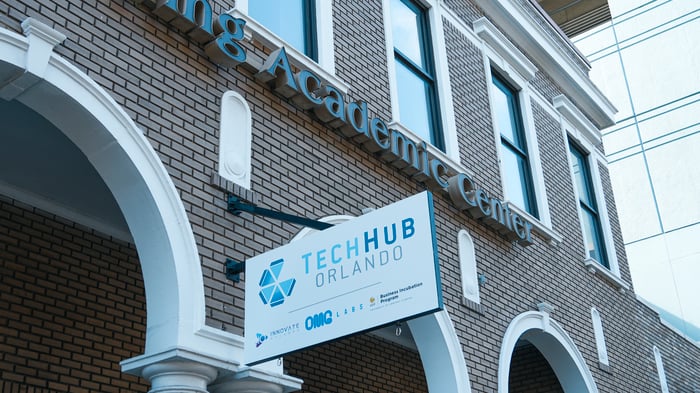
Need a venue for your next event or workshop? Host at Tech Hub Orlando!
| Check us out! |