*Photo: Innovate Orlando
In 2025, Central Florida finally stopped politely waiting to be discovered and just kept launching rockets, training soldiers, detecting cancer, and building billion-dollar companies, whether anyone was paying attention or not.
The contracts got bigger, launch cadence accelerated, and founders raised more ambitious rounds. Underneath it all, the same technical stack kept showing up in very different places.
At first glance, the year looked like unrelated wins: a defense contract here, a new attraction there, a record launch week on the Space Coast. Look closer and a pattern emerges: the same talent and technologies powering defense also run hospital systems, optimize launch operations, and build immersive experiences. Once you see that common stack, 2025 stops looking like headlines and starts reading like an operating system.
(And yes, that operating system has been running this whole time. No, it does not require a theme park ticket to access it.)
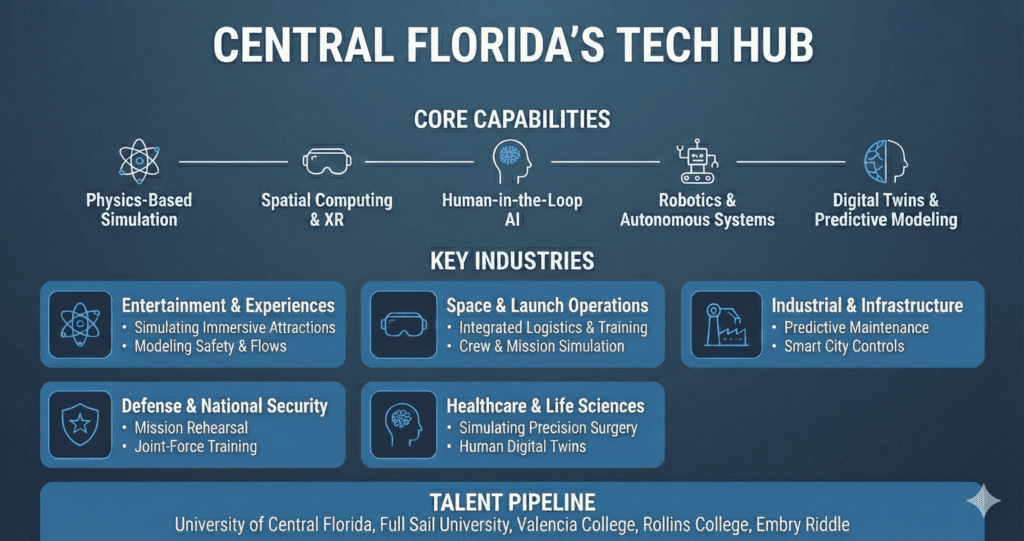
At the core: physics-based simulation, real-time 3D, human-in-the-loop systems, robotics, and digital twins. Those capabilities show up in military training facilities, hospital innovation labs, launch operations, and theme park attractions. This is not five separate economies. It is one technical stack that different customers pay for in different ways.
Here is what makes that gap real: Orlando’s tech workforce grew roughly 15-21% over five years versus 11% nationally, reaching approximately 78,000-80,000 workers according to regional economic development data. The median tech industry wage is approximately $103,000 and the average salary runs around $106,000 according to CompTIA’s 2025 analysis, in a metro where median home prices run roughly $90,000-125,000 below Austin’s. Yet Orlando raised an estimated $9,500 in venture capital per tech worker in 2025 versus Austin’s estimated $62,000 per worker.
To put that another way: Orlando has comparable workforce growth, better cost fundamentals, and customers who sign contracts measured in billions but gets one-sixth the venture attention per worker. That is either a spectacular market inefficiency, or proof that geography lessons in coastal VC firms ended somewhere around 1995.
HOW FOUNDERS SCALE INTO ECONOMIC DEVELOPMENT STRATEGY
The most encouraging part of 2025 was not just infrastructure growth. It was watching how momentum from scaling companies translates into lasting economic impact when the right connective tissue exists between founders, anchor institutions, and regional strategy.
Here is how that actually works: A founder building technology for health care can pilot at Orlando Health or AdventHealth, two of the region’s largest employers. If the product proves out, they can access NIH-funded research partnerships through UCF, apply for federal SBIR contracts leveraging the region’s defense relationships, and eventually scale into national health systems. That is not a linear path from seed to exit. It is a lattice where startups plug into multiple revenue streams, research partnerships, and customer channels that most regions cannot offer in one place.
ThreatLocker demonstrates this clearly. By 2025, the cybersecurity firm surpassed a $1 billion valuation according to private-market data, launched new product lines, and landed on the Inc. 5000 list of fastest-growing private companies. The company chose to headquarter and scale in Central Florida, employing over 500 people and proving a firm with global customers can grow from here rather than just open a satellite office.
On the capital side, the most important story is not about a coastal firm opening an outpost. It is about local investors building larger platforms because they understand the regional advantage. After more than a decade as an angel with Entrenext Ventures, backing Orlando companies in software, proptech, and space communications, Jonathan Taylor signaled his solo-investor chapter is ending and he will launch a new investment team in 2026. Reflecting on exits like Tropo, SightPlan, and PhotoDay, he noted he has been investing in machine learning and “data centers in space” for roughly ten years, long before those phrases became headlines.
His observation captures the moment: what Orlando has been building quietly is now what the market is pricing in. To quote his Hemingway reference, change arrives “gradually, then suddenly.” For those who have been here, 2025 was the “suddenly” year. While coastal VCs were still asking “Where is Orlando on the map?” (a question that says more about their atlas budget than our ecosystem), local investors who understood the defense-to-commercial crossover were already writing checks.
Other founders used 2025 to close meaningful rounds that leverage the local stack. Worth, led by co-founders of Orlando’s first unicorn, raised $25 million to apply machine learning to small-business credit. Attuned Intelligence secured $13 million to bring supervised automation into hospital operations, directly leveraging proximity to major health systems. Zero Networks raised a $55 million Series C for cybersecurity.
At the infrastructure level, NeoCity crossed $500 million in cumulative public and private funding and shifted from site prep to production milestones, with first commercial wafers expected in late 2026. This is not just about manufacturing jobs. It is about creating domestic semiconductor capacity tied directly to defense and aerospace supply chains, which means the startups building hardware for those customers can now prototype and produce locally. Kratos’s $356 million acquisition of Orbit Communication Systems reinforced the space and communications side of the ecosystem, adding engineering talent and production capacity.
This is the economic development strategy in motion: anchor the region with $6 billion in defense simulation work and 100+ annual space launches, build the research and lab infrastructure that lets startups access that customer base, add semiconductor and advanced manufacturing so hardware companies can scale here, and create the capital formation mechanisms so founders can raise and grow without leaving. When that flywheel works, you get companies like ThreatLocker at $1 billion, Worth raising institutional rounds, and investors like Jonathan Taylor building funds to do it again.
Across all sectors, Orlando-area companies raised approximately $750 million across more than 130 deals in 2025 according to regional capital tracking. To put that in perspective: Austin raised approximately $5 billion, Miami raised roughly $2 billion in the first half alone. Orlando’s total is a fraction of that. But the combination of deep customer presence, federal research infrastructure, and growing local capital means founders have more options to build and stay than they did even two years ago.
FROM TRAINING SOLDIERS TO TREATING PATIENTS
The clearest place to see the stack is defense and simulation. Within one square mile of Central Florida Research Park sit the Army’s Capability Program Executive for Simulation, Training and Instrumentation (CPE STRI), the Simulation and Training Technology Center (STTC) under DEVCOM Soldier Center, and Naval Air Warfare Center Training Systems Division (NAWCTSD), the Navy’s only independent Federal Laboratory command physically headquartered in the Research Park. That density of acquisition authority, lab-grade research with cooperative agreement authority, and tech transfer in one geography anchors roughly $6 billion in annual modeling and simulation work.
Which is a technical way of saying: If the U.S. military needs to train someone to do something dangerous before they do it for real, there is a very good chance the software powering that training was built within a fifteen-minute drive of a really good Cuban sandwich.
Here is what that looked like in practice: Cole Engineering landed a $62 million Army contract for next-generation Stinger training systems. The Training and Simulation Industry Symposium drew hundreds of defense leaders to Orlando to map future requirements. Red 6 advanced augmented-reality pilot training onto new rotorcraft platforms.
The same mindset is crossing into health care. Orlando Health expanded its Digestive Health Institute in 2025 and advanced tools for early pancreatic cancer detection, building on research pilots from prior years. At UCF, researchers secured NIH funding for biosensors that can detect Hepatitis B, C, and HIV from a single sample and advanced smartphone diagnostics that move monitoring out of hospitals.
In other words: the same people who train pilots to avoid threats are now training algorithms to detect tumors. That is not a pivot. That is the operating system behind America’s training and health infrastructure. And if that sentence does not make you reconsider what Orlando actually does, I genuinely cannot help you.
Let’s be honest about the risk: $6 billion in defense contracts means concentrated customer exposure. If Congress redirects spending or the Pentagon restructures, this ecosystem feels it fast. But the Pentagon’s FY2026 budget explicitly prioritizes simulation and training as strategic, not discretionary. And commercial customers in health, logistics, and security mean the region is no longer 100% dependent on federal buyers. (Though we would very much prefer Congress keep funding the technology that lets us train soldiers without putting them in actual danger. That seems like an exceptionally reasonable use of tax dollars.)
SPACE, LOGISTICS, AND EXPERIENCES RUNNING ON THE SAME CORE
Drive forty-five minutes east and the same stack shows up at orbital scale. The Space Coast passed 100 launches in a single year as SpaceX, ULA, and Blue Origin pushed cadence from Cape Canaveral. Permitting moved forward on a Starship complex that could eventually support dozens of heavy-lift missions annually.
Which means that when you are sitting in I-4 traffic (and you will be sitting in I-4 traffic), there is a statistically meaningful chance the person in the car next to you designed something currently orbiting the Earth. You are welcome for that existential thought.
On the ground, logistics companies like OneRail scaled last-mile delivery from Orlando offices, earning FreightTech 100 recognition for the fifth straight year. The airport’s $6 billion modernization began integrating air-taxi planning into runway and terminal design, making Orlando a live testbed for advanced air mobility.
The entertainment sector remained the most visible proof of concept. Epic Universe opened as a large-scale demonstration of real-time 3D, digital twins, and advanced manufacturing delivered at theme-park scale. When Unreal Fest came to the Orange County Convention Center, local teams won prize support for projects in smart cities, infrastructure, and simulation. The game engines running those attractions are the same ones defense contractors and industrial firms use for mission-critical training.
So the next time someone confidently announces that “Orlando just does tourism,” you can politely mention that the Unreal Engine powering their favorite video game, the digital twin optimizing their city’s water system, and the simulation training the people defending this country all share the same technical foundation. And yes, that same foundation also powers the Harry Potter ride. Because why would you not use world-class real-time rendering for both fighter pilot training and theme park attractions? That is called efficiency.
THE GAP AND WHAT HAPPENS NEXT
Step back and a few things become clear. Central Florida counts roughly 78,000-80,000 tech workers with growth rates roughly twice the national average. The Space Coast is one of the busiest launch ranges on the planet. Major infrastructure projects represent many billions in current and planned investment. Regional venture activity continues to build momentum even as it remains a fraction of larger hubs.
That gap creates opportunity. For founders, it means selling into health systems, defense customers, launch providers, and global brands in the same week while operating in a market where talent, real estate, and operating costs run well below coastal alternatives. For local leaders, it means stewarding an economy that underpins national security, space infrastructure, and health care innovation even when perception lags reality. For investors, it means building theses around a proven technical stack in a market where entry valuations and competition remain more favorable than in Austin, Miami, or the coasts.
The work for 2026 is not to reinvent Orlando. It is to connect players still working in parallel, protect the defense and space infrastructure anchoring everything else, and ensure that capital markets and national narratives reflect what is already built.
Three things to watch: Can ThreatLocker and a second company cross the $1 billion exit threshold? Do NeoCity’s first commercial production runs land on time? Does Jonathan Taylor’s new fund catalyze a second wave of local institutional capital? If those three things happen, the story in 2027 will not be about an “emerging” market. It will be about the place that quietly became indispensable while everyone else was watching Austin and Miami.
WAYS TO PLUG IN
If you are a founder selling into defense, health, space, or entertainment make sure you are registered in the region’s ecosystem map, we are working on ways to leverage this to create more accurate warm introductions to connect our ecosystem. Then make sure you are paying attention to our community calendar to keep up with all the region’s tech events and if we are missing one, let us know.
If you are a commissioner or public-sector leader and need a briefing on what $6 billion in simulation work, $500 million in semiconductors, or a $6 billion airport modernization means for jobs and resilience in your district, email sheena@innovateorlando.io with subject “Briefing Request” and your topic. You will get translation, not jargon, and clear questions you can take back to your teams.
The stack is here. The gap is still here. And in 2025, we stopped waiting for permission to matter.
See you in 2026 at the Orlando Tech Summit & Community Awards in February, on a launch pad in Brevard, in a hospital innovation lab in Lake Nona, or in a simulation facility in Research Park. Wherever you plug in, just make sure you do.
This is what an innovation economy looks like when it is by design, not by accident. Protect it. Fuel it. Make sure the rest of the world knows it runs through Orlando.